
Trace Former Barton County Property Owners by Era
Former Barton County property owners surface through record systems stacked one on another. Work backward from the newest deed. Hold the legal description constant at every step. It is the thread that ties each era of records to the next. Remote recorded-document coverage reaches into the 1950s. Courthouse books plus historical collections carry the property search onward toward the county's 1870s records and United States patent deeds.
| Source | Years It Covers | Where Held | What It Shows |
|---|---|---|---|
| eSearch/RAP index | 1950s forward | Remote paid portal | Names, legal descriptions, book/page or document leads |
| Deed books and manuscript records | 1870s forward | Register of Deeds courthouse | Recorded conveyances, patents, and prior references |
| KSHS plat books | 1902 and about 1916 | Kansas Historical Society | Dated township-owner snapshots |
| KSHS county records | About 1870-1977 | State archives finding aid | Probate, district, and county context |
Build the modern chain online first. Go to Suite 205 at the courthouse. That is where the work continues once a chain crosses the online cutoff, and historical maps and newspapers stay useful as clues only, since the recorded instrument or court order remains the ownership evidence.
Decode Barton's D, G, and Unprefixed Books
Barton's recorder prefixes changed over time. Deed books through 250 carry a D, general records through 578 carry a G, and later books use no prefix at all. Retry any failed remote reference under that convention. Or ask the Register of Deeds to interpret it. Preserve the number exactly in your research log, and consult the county recorder login and terms before paying for image access.
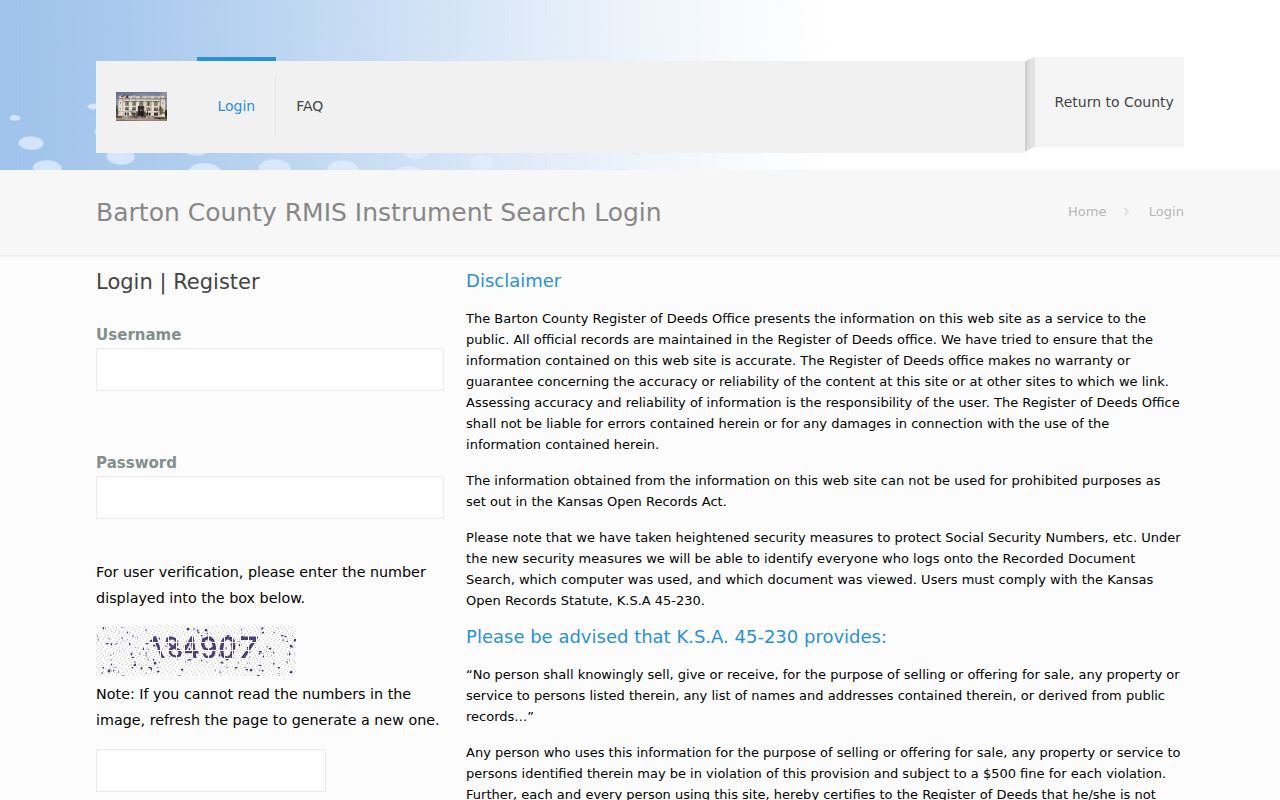
Remote index access requires credentials and verification, as the login confirms. The courthouse record remains the official source.
Bridge Prior Owners with Barton's 1902 and 1916 Maps
The Kansas Historical Society catalog lists a 1902 Barton plat book and an atlas from about 1916. For rural land, compare the printed owner against township, section, quarter, acreage, roads, and adjacent parcels. Remember that a map is a dated clue. It cannot prove ownership between publication years. Historic aerial imagery from 1938, 1957, 1973, and 1985 adds physical context to the tract. A shifted field line never replaces the conveyance chain.
Reconstruct the Barton County Deed Chain Backward
Each deed supplies the name for the next search. Keep a dated table of transfers. Log the date, grantor to grantee, deed type, legal description, and book/page or instrument number, and never follow a surname alone once the land description stops matching.
- Find the current owner's acquisition deed with that owner as grantee.
- Copy the grantor, legal description, recording date, and prior reference.
- Search that grantor as an earlier grantee and verify the same land.
- Repeat through the 1950s cutoff, then continue in courthouse deed books.
- Grantor / grantee
- The conveying party and receiving party.
- Chain of title
- The linked sequence of instruments affecting the land.
- Reverse index
- An index route used to locate a party in the opposite role.
- Warranty / quitclaim deed
- Different conveyance forms; neither label alone proves a complete chain.
Start Early Barton Chains with Patent Deeds
Barton County's earliest manuscript land records include United States patent deeds. County office records reach into the 1870s. Those instruments predate today's parcel numbers entirely. Start from the last verified courthouse deed. Keep its township, section, quarter, addition, block, and lot terms intact as you move backward into the manuscript series. Never guess at a modern address translation. The county was organized in 1872. Rail and town-company growth shaped Great Bend and nearby towns at that time. A patent, town-company paper, or early plat may open the documentary path. Even so, every later transfer still needs its own grantor-grantee link.
Match Former Barton Owners Across Address Changes
A current 911 address may never appear in an older deed, atlas, directory, or newspaper. Barton Communications assigns those addresses. The modern tax form also keeps property-address fields separate from owner and legal-description fields. Search an older tract by its legal description instead. Old street numbers, subdivision names, and section-township-range calls also work. Urban chains should preserve addition, block, and lot. Rural chains should retain section, township, range, quarter, acreage, and any exception. A parcel was sometimes split. When that happened, note the parent reference and the plat or survey that created the newer parcel. That way a renamed road or readdressed home cannot break the former-owner timeline.
Follow Barton Estate and Court Transfers Backward
A clean chain can break in several ways. An owner may have died. A marriage may have changed a surname. A court may have ordered a transfer, or a trustee may have conveyed the land. Search death and survivorship affidavits, transfer-on-death instruments and revocations, personal-representative deeds, powers of attorney, probate dockets, quiet-title matters, foreclosure records, and sheriff's deeds. Match each item to the full legal description first. The Kansas District Court public portal offers case information, not the official filed record. Search party and entity variations, note the case number, and get the actual order from the clerk when it affects ownership. Restricted vital records are not a public people index.
Use Barton Newspapers as Leads, Not Title Evidence
The Library of Congress carries the Barton County Democrat from 1885 through 1915, and the Great Bend Public Library holds Great Bend Tribune microfilm back to 1908. Search legal descriptions, unusual surnames, estate notices, sheriff sales, quiet-title notices, and subdivision announcements. Record each publication date and page. Then locate the underlying deed or court filing. City directories and census records help separate people who shared a name, yet only the recorded instrument and the controlling court order belong in the legal ownership chain. An obituary suggests relatives, not heirs. A sale ad does not prove a closing. Newspapers open doors, in other words, but the recorded evidence settles each link.
Keep a Reproducible Barton Ownership Timeline
Every transfer deserves the same details. Log the instrument date and the recording date. Record the grantor, the grantee, and the deed type. Note the exact legal description, the book and page or document number, and any prior reference. Note where each fact came from, too. A careful table like this exposes skipped years, correction deeds, name changes, and parcel splits. A casual read would miss those clues. Label any uncertain link as a gap. Do not smooth it over with a map label or a family assumption.
Go Back from Barton's Online Index to the 1870s
A chain that stops is not a dead end. Identify the last verified instrument. Then name the courthouse book, archive series, probate file, or title-professional review that comes next. A labeled gap serves you far better than an unsupported owner of record.
The online Barton County deed index only begins in the 1950s. Manuscript land records and United States patent deeds reach back into the 1870s. The KSHS Barton finding aid lists county, probate, and district material. It spans roughly 1870 to 1977. Confirm the series and reel before you travel. A catalog entry is not a certified county copy of the deed.
Online cutoff. Barton eSearch reaches only to the 1950s; older prior owners require courthouse books, microfilm, or archival leads.
Put former-owner research to work on property history, estate matters, and due diligence. Never use historical property records to stalk or harass a living person.