
Separate the Fields in Barton County Property Tax Records
Barton County property tax records do not place every answer in one office. The Appraiser discovers, lists, and values taxable and exempt property as of January 1. The Treasurer's search handles tax-type, year, taxpayer, location, and status criteria. Record the office and year beside each figure before comparing them.
| Field | What It Shows | Where |
|---|---|---|
| Appraised value | County estimate used before class percentage | Appraiser |
| Assessed value | Appraised value multiplied by the statutory class rate | Appraiser |
| Tax type and year | The account category and billing period | Treasurer search |
| Current or taxes due | Status filter, not a foreclosure judgment | Treasurer search |
| Subdivision or land grid | Location filters that identify the correct tract | Treasurer search |
Assessed value is only a tax calculation input. It is not the last sale price. The tax amount is not a market appraisal either, and a change in class, exemption, levy, or year can move the bill without any matching change in what the property sold for.
Barton's Tax Form Searches Seven Account Types
The official Barton County tax search offers type boxes labeled RL, PP, OL, GS, TK, MN, and SA. The codes cover real estate and other county account classes. The form digs much deeper. A tax-year range, unit and parcel fields, current-tax and taxes-due choices, owner or taxpayer match modes, street details, subdivision, block, lot, section-township-range, lease name, and quick reference round out the page.
| Search group | Fields available | Use |
|---|---|---|
| Identity | Owner, taxpayer, both, parcel, quick reference | Match the person or stable parcel key |
| Time and status | Start/end year, current tax, taxes due | Keep one tax period from another |
| Urban location | Street, subdivision, block, lot | Find city parcels without a full ID |
| Rural location | Section, township, range, lease | Find land and mineral-related accounts |
The Treasurer's database shows a September 8, 2026 update. That stamp does not guarantee each payment, deed, or appeal posted at the same instant, so treat it as a general refresh rather than a promise about any one account.
The Barton Tax Criteria Page Shows Its Scope
One simple tax lookup hides many definitions. The Barton tax criteria page shows its full scope. Open the Barton Treasurer tax search and verify the live controls before relying on a saved picture of the form.
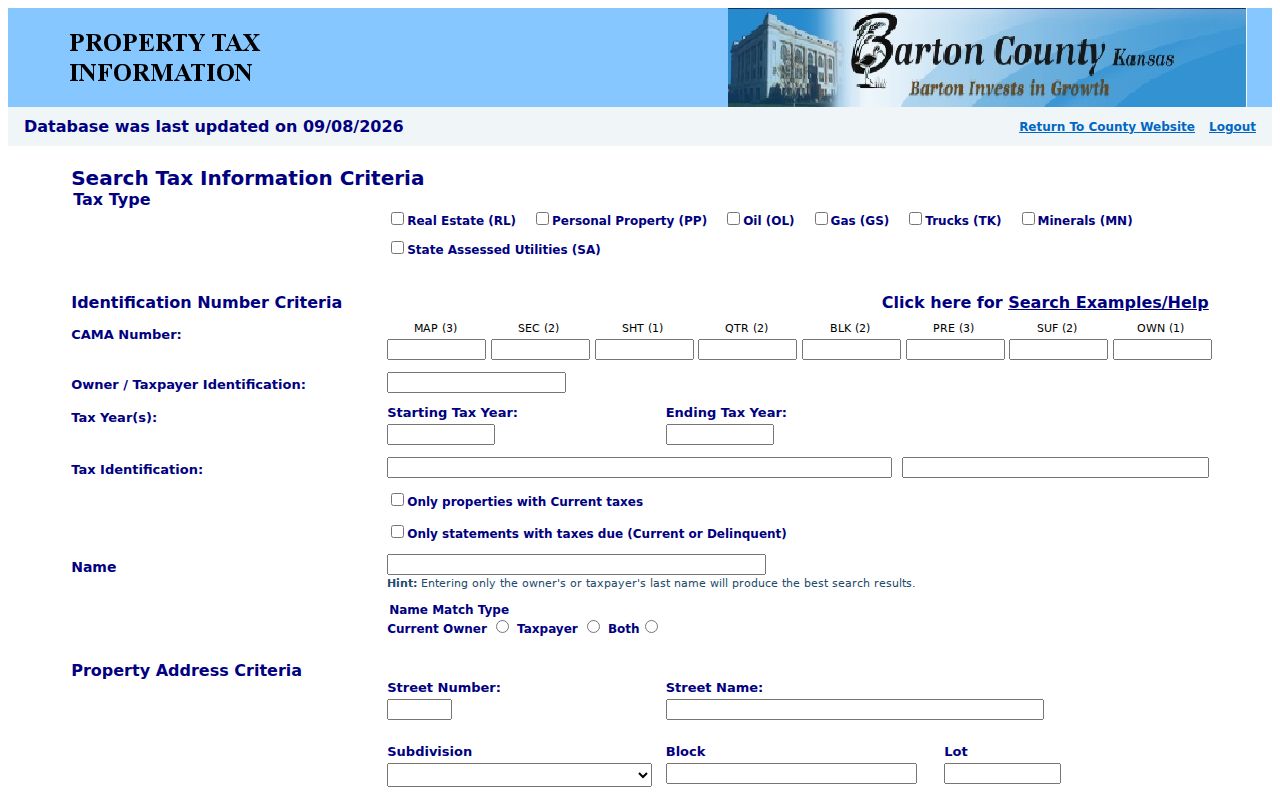
Those separate type, year, status, name, address, and land-grid fields exist for a reason. A broad surname search can mix unrelated accounts because nothing in the form forces you to narrow the field.
Look Up a Barton County Tax Bill With a Parcel Key
Look up the site address in ORKA or the Appraiser portal. Save the full 19-digit Barton parcel number. It begins with 005. Then use the tax search to locate the correct account, narrow to the relevant year and status, and compare owner, taxpayer, address, subdivision, and land-grid description before accepting the match.
- Identify the parcel by address and copy the full parcel and quick-reference numbers.
- Select the right tax type and enter a single year or a deliberate year range.
- Confirm the taxpayer, situs, legal location, and parcel before reading status.
- Compare the value and class with the Appraiser's record for the same year.
- Ask the Treasurer about a payment, delinquency, or sale question that the result does not settle.
- Assessed value
- The appraised value after the statutory class percentage is applied.
- Mill or levy
- A rate used with assessed value to calculate tax.
- Exemption
- A statutory treatment that can remove or alter taxable property or value.
- Tax lien
- A legal claim tied to unpaid tax, which is distinct from a mere search filter.
Residential Property Uses an 11.5 Percent Class Rate
Barton County's tax calculation guide draws a clear line between appraised and assessed value. Its residential example shows the arithmetic. Kansas applies an 11.5 percent class rate to $120,000 of appraised value. The result is $13,800 in assessed value. That comes before the levy is used. The example is a formula, not a live parcel's value or bill.
Agricultural, commercial, vacant-lot, and other classifications can follow different statutory treatment. Pair the class and year with every number. The levy enters after assessed value is set. Two parcels with the same appraised amount can still differ sharply once class, exemptions, tax units, or special assessments enter the math. A higher bill does not prove rising market value. Copy appraised value, assessed value, class percentage, levy year, and tax status into separate fields before doing any arithmetic.
The type boxes matter most for land tied to oil, gas, mineral, or utility interests. A real-estate account can hide separately assessed interests. Search the relevant category on its own. Then compare owner or taxpayer label, parcel or CAMA segments, lease name, and year.
The Register holds recorded oil-and-gas leases, assignments, releases, water rights, and pipeline instruments, so check there when ownership reaches past the surface tax account.
January 1 Anchors Barton County Valuation
The Appraiser values real property as of January 1. Kansas law also requires reinspection of each real property at least once every six years under K.S.A. 79-1476. A field inspection can occur even when no recent deed or permit has changed the parcel.
The 2026 Annual Market Trend Study, dated February 11, 2026, discusses residential inflationary trends, area-specific adjustments, stable commercial property, vacant lots, manufactured-home cost tables, and agricultural use-value factors. It describes valuation work for that cycle, not a live sale price.
A reinspection, market study, sale validation, and tax payment belong to different stages of the record. The Appraiser may inspect physical characteristics or use area sales without a deed changing hands on the subject parcel. A Sales Validation Questionnaire supports appraisal work but does not replace the recorded conveyance. The Treasurer then applies the relevant tax-year account process after values and levies are established.
When a building or land characteristic seems wrong, gather dated evidence tied to that field. Useful material can include exterior photographs, repair documentation, comparable sales, a signed appraisal, income and expense data for an income-producing parcel, a survey or plat, and city permit or demolition records. Evidence should address the January 1 condition and the disputed characteristic. A later renovation or later sale may be important context but does not automatically establish the earlier valuation date.
Note: Compare records from the same year; a 2026 appraisal figure and a 2025 tax bill answer different date questions.
Forms Connect Values, Exemptions, and Protests
The Appraiser's forms and documents page collects everything from valuation appeals and Payment Under Protest forms to Sales Validation, exemption, and Neighborhood Revitalization paperwork. Pick the form that matches the real problem. A correction to parcel facts, a statutory exemption, and a disagreement over market value are separate requests. Each one travels through a different lane. Bring the parcel number, the notice, the valuation year, and evidence suited to the property, such as photos, repair records, comparable sales, or income data. Keep proof of filing and know your review stage.
Challenge a Barton County Assessment Through the Proper Lane
Barton County offers two ways to contest a valuation. The first is an informal equalization meeting held after the valuation notice. The second is a Payment Under Protest. That route attaches to the tax payment itself. Further review can continue to the Kansas Board of Tax Appeals and then down the judicial path. The notice or payment route sets the deadline. So read the current form and notice rather than trusting a generic calendar date.
Appeal window. File within the deadline printed on the current Barton County notice or protest form. Contact the Appraiser promptly because the research did not establish one universal date for every appeal route.
Tax Due Does Not Mean a Sale Has Occurred
A "taxes due" flag is only an account status. It is not a foreclosure judgment. It is not a sheriff's sale confirmation or a recorded deed either. Distressed-property questions deserve a closer look. Confirm the year and amount with the Treasurer, then search Kansas District Court case information and the Register of Deeds for filings or a later conveyance. The court portal is not the official record. A complete filing may require a courthouse terminal or a request to the Barton District Court clerk. The county publishes no official tax-sale calendar, so a portal flag should never be read as a predicted sale date.
Resolve Barton Tax Discrepancies by Year and Source
When values disagree, label the numbers before comparing anything. Separate appraised value, assessed value, taxable value, class, levy year, and special assessments. When status disagrees, confirm the tax type and year. Real estate, personal property, oil, gas, mineral, truck, and utility searches can return very different accounts tied to related names or the same land.
The Treasurer sits in the Barton County courthouse in Great Bend. Payments and account status live there. The Appraiser owns valuation and property characteristics. Ownership belongs with the Register of Deeds. Keeping the roles straight stops a tax record from being asked to prove a deed fact.
A conveyance dispute calls for the latest deed. A court-ordered sale question needs the judgment first, then the recorded transfer. For acreage, compare the deed, plat, GIS geometry, and a survey. Tax records add one dated layer.
Track the search in a worksheet. Save the source URL, retrieval date, displayed update, exact criteria, tax type, year, parcel ID, quick reference, name-match mode, and status. That record pays off when a screen changes after payment or an annual roll update. Was the difference timing, category, or the wrong parcel? A repeatable search answers that question.