
Check Barton County's Current Owner Record
The Barton County Appraiser maintains the assessment roll that answers current ownership. Start there. Log in through the CIC appraisal portal as a public user, or locate the tract in ORKA. Both routes return the same current roll entry.
| Owner of Record | The person or entity carried on the current assessment roll. |
|---|---|
| Mailing Address | Where notices go, which may differ from the property location. |
| Situs Address | The physical parcel location, not proof of occupancy. |
| Parcel ID | The 19-digit Barton key beginning with 005. |
| Quick Reference | A second cross-system lookup key. |
| Legal Description | The land description used to confirm the deed. |
An owner of record is not always an occupant. A post-office box or out-of-county mailing address shows where the county sends correspondence, nothing more. Copy the owner, situs, and mailing fields separately.
Preserve Barton's 005 Parcel Identity
A name alone proves little. The strongest check pairs it with the full 19-digit parcel ID, quick reference, and legal description. Leading zeroes matter here. That identifier set separates neighboring lots and matching surnames, and it links ORKA to the appraisal, tax, and deed records.
- Owner of record
- The name associated with the assessment roll.
- Assessment roll
- The Appraiser's tax-administration record.
- Situs
- The physical location of the parcel.
- Recording lag
- The gap before a recorded transfer appears in another county system.
Date the Barton Appraiser Result
The public portal publishes its own update stamp, most recently September 4, 2026 at 5:00 PM. That stamp describes the database, not the deeds. It is no guarantee of a fresh recording. Save the stamp and your retrieval date, then open the Barton public-user portal to begin.
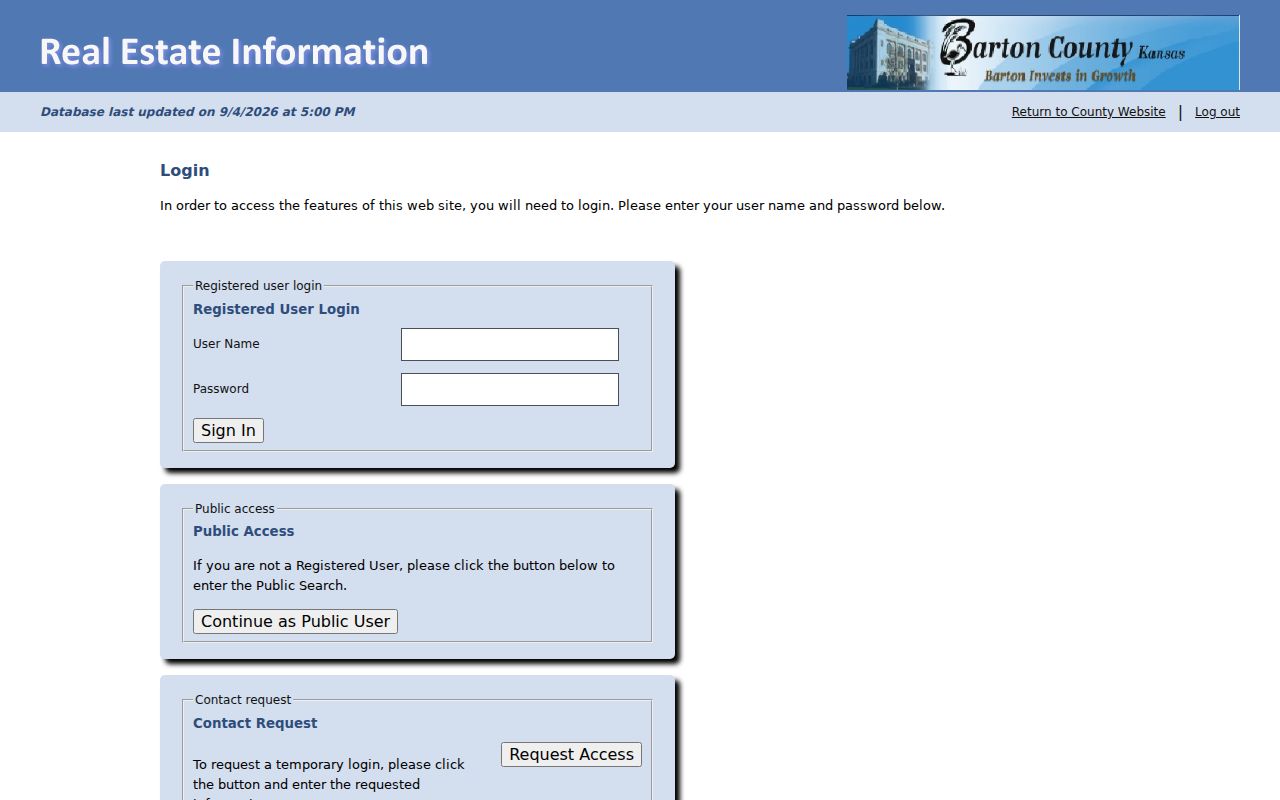
The public route is free, while enhanced features may require a paid subscription.
Verify the Current Barton County Owner
The roll gives an administrative answer only. The newest recorded deed confirms the conveyance. Search deed records by owner name and full legal description, and compare the effective date with the recording date.
- Read the owner of record and identifiers in the Appraiser portal.
- Search that owner and legal description in the Register of Deeds index.
- Compare the newest deed's grantee, recording date, document number or book/page, and land description.
- If sources differ, retain both results and ask whether an appraisal transfer is pending.
- Owner of record
- The party the roll currently associates with the parcel.
- Vesting
- The deed language describing how the grantee holds title.
- Registered agent
- A business contact, not automatically the parcel owner.
Account for Barton's Unfixed Update Lag
No official update schedule exists. The recorder's three-to-seven-business-day note is a document-return estimate only. A deed recorded yesterday may not appear on the appraisal roll yet, so confirm recent transfers with the newest deed and ask the Appraiser directly.
Recent-sale caution. A roll may trail a transfer; the latest recorded deed is the better evidence of the newest conveyance.
Read Barton Trust and Entity Owners Literally
A roll may name a trust, estate, limited-liability company, or corporation. It may also list a person acting under a power of attorney. Copy the full name and role exactly. Never substitute a trustee, beneficiary, manager, or registered agent as owner. Do that only if the deed supports it. The county land record controls the parcel. Entities can be checked through the Kansas Business Entity Search.
Respect Protected Barton Owner Addresses
Kansas Safe at Home supplies substitute addresses and mail forwarding for qualifying victims. Never try to uncover a protected physical address. K.S.A. 45-230 also bars turning public names and addresses into unauthorized sales lists. Keep any Barton County owner search tied to a legitimate property purpose.
Read Barton Entity and Estate Owners Precisely
The current owner may be a trust, estate, limited-liability company, corporation, or a person acting through a power of attorney. Copy the complete name and role words. Search the deed under the same legal description, trying reasonable registered-name variants. The Kansas Business Entity Search verifies an entity's formal name. Its registered agent does not thereby become the parcel owner.
Estate and survivorship transfers can leave systems out of step. Look for personal-representative deeds, transfer-on-death instruments or revocations, death affidavits, survivorship material, and probate orders. Vital records stay restricted. They are no public owner-search shortcut. The recorded land instrument remains the county's confirmation.
Separate Barton Mailing Addresses from Property Locations
The mailing address shows where assessment and tax mail goes. The situs is the land itself. An out-of-county address, post-office box, or management office proves nothing about occupancy. A rural 911 address can also differ from an older route or deed description, since Barton Communications assigns modern addresses and may field-verify them.
Kansas Safe at Home gives qualifying victims a substitute address and mail forwarding. Never infer a protected location. K.S.A. 45-230 restricts misuse of public names and addresses. Keep the parcel facts that answer the property question, and leave unrelated personal details unpublished.
Document a Barton Current-Owner Discrepancy
A roll-deed mismatch deserves care. Save the portal update date, retrieval date, parcel ID, both owner names, and the deed reference. Ask the Appraiser whether a transfer is pending. Ask the Register of Deeds about a later instrument. Address and acreage gaps stay visible until the proper custodian, recorded plat, or licensed survey settles them.
Use a Barton Owner Record Responsibly
Keep the legal description, parcel ID, displayed owner label, and retrieval date together. That compact record lets anyone repeat the check. It also stops a contact address or a similar name from attaching to the wrong land.
A mailing address is a lawful contact point, not proof of residence. Keep the inquiry narrow. Identify the parcel first. Skip republishing personal details that never answer the property question.
Lawful use. Use owner information for legitimate property research, never to stalk, harass, intimidate, or expose a protected location.