
Barton County Property Value Types
A Barton County property value is really several figures wearing one label. The Appraiser's office sets market value, also called appraised value. It then derives an assessed amount using Kansas property classes. The Treasurer takes that assessed amount and folds it into the tax process. Levies and other charges come in there as well. A deed records a conveyance. But the county's online parcel cards publish no last-sale price or date field. Label every number before you compare it.
| Value | What It Is | Where |
|---|---|---|
| Appraised or market value | The county's estimate of fair market value as of the assessment date | Barton County Appraiser |
| Assessed value | Appraised value multiplied by the Kansas class percentage | Appraiser and tax records |
| Sale consideration | The amount stated in a conveyance when the instrument discloses it | Recorded deed or related instrument |
| Private appraisal | An opinion prepared for a specific transaction or purpose | Licensed appraiser, not the county roll |
Kansas does not treat assessed value as a sale price. It is built from class percentages. Residential property and farm home sites sit at 11.5 percent. Commercial and industrial parcels carry 25 percent. Vacant lots carry 12 percent. Agricultural land carries 30 percent of use value. Other classes have their own rates. So two parcels with identical appraised values can end up with very different assessed amounts.
Barton County Assessment Date
Real property is appraised as of January 1. Kansas law calls for annual value updates, and Barton County must reinspect all real property at least once every six years under K.S.A. 79-1476. Reinspection is not the same as a sale inspection. It supports a mass-appraisal system that aims to value many properties on a common basis.
Changes in use, class, structures, land characteristics, and market evidence can alter the value from one year to the next. Keep the tax year beside each amount. A current-looking portal may display a different year than an older notice, deed, or tax statement. Comparing unlabeled figures can create a false gain or loss.
Barton County Residential Assessment Math
The county's own tax-calculation material walks through the math with real numbers. Picture a residential parcel appraised at $120,000. The 11.5 percent class rate turns that into $13,800 of assessed value. Applying 120 mills yields $1,656 before special assessments and school general-finance effects. Those figures illustrate the method. They are not any particular parcel's bill. The distinction is vital. Appraised value is the county's fair-market estimate. Assessed value is the class-adjusted base. A mill levy enters later in the tax calculation. The separate Barton County property tax records page covers bills and appeal routes; the value question stops at what each amount means.
Barton County 2026 Value Trend
The Appraiser's annual market trend study is dated February 11, 2026 and addresses values as of January 1, 2026. It reports a general inflationary residential trend, but says conditions vary by area. Commercial property is described as stable without a general trend. Vacant lots show an inflationary trend. Manufactured-home cost tables draw on make, age, condition, and CoreLogic Marshall & Swift data.
A countywide trend is not a parcel appraisal. Neighborhood, class, land use, improvements, and condition still matter. Agricultural use values also respond to cropping, commodity prices, and production costs. Use the study to explain broad movement, then use the record tied to the exact 005 parcel ID for the individual amount.
Check Barton County Property Value
The Barton Appraiser portal offers a free public-user route. Enhanced tools sit behind a subscription. Begin with the parcel's identity rather than a value copied from another site. ORKA can supply the site address, legal description, quick reference, and the 19-digit parcel ID beginning with 005. Those keys guard against a same-name or nearby-address mismatch.
- Enter through Continue as Public User and search with the address or a parcel identifier.
- Confirm the legal description and class before saving the appraised and assessed amounts.
- Record the valuation year and portal update date shown at the time of retrieval.
- For a transfer amount, inspect the recorded instrument instead of assuming an unverified sale field exists.
- Assessed value
- The class-adjusted figure used in the tax calculation.
- Market or appraised value
- The Appraiser's estimate based on the Kansas fair-market standard.
- Assessment ratio
- The statutory class percentage multiplied by appraised value.
- Reassessment
- A new valuation for a later assessment year, not a private sale appraisal.
The portal labels each value field on its result card during a live search. Trust those on-screen labels, and do not invent or rename a field.
Barton County Value Source Dates
The Appraiser's public landing page displayed a database update. It was September 4, 2026 at 5:00 PM. The Treasurer search carried a September 8, 2026 update. Separate county systems refresh on different schedules. Those dates do not prove the effective date of every field on one parcel. Save the retrieval date and the screen update date alongside any value you record. A new deed, split, demolition, or improvement may not have reached the appraisal display yet. Ask the Appraiser about its status. Barton County publishes no fixed interval between deed recording and an Appraiser or Treasurer update. The Appraiser public entry page shows the login screen. It also offers the Continue as Public User route.
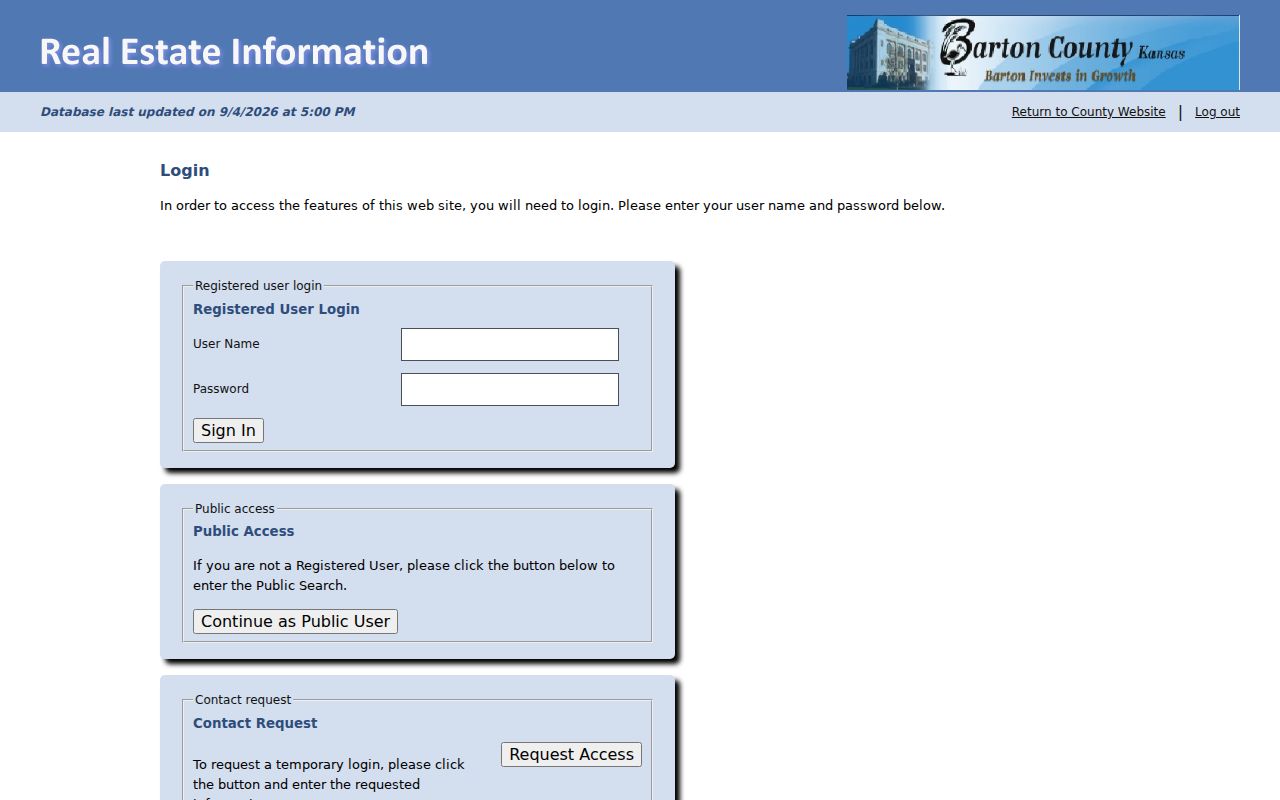
The public entry is free, with paid enhanced access offered by subscription.
Request Barton County Value Records
When the public search stops short of the year or detail you need, ask the Appraiser directly for a property record card or valuation notice. Give the parcel ID and the tax year. Say whether you want land, building, class, prior-year value, or appeal history. Requests can be this precise.
The posted fee schedule prices property-record cards and screen prints at 50 cents per page, standard queries at $5 plus copies, and custom queries at $10 plus copies. Confirm current charges before ordering. Owner information is different. It requires a signed open-records form under the posted county process. A precise request saves staff time and keeps a value record from getting tangled with an ownership data request. Kansas Open Records Act fees may include actual costs and staff time.
Barton County Property Class Effects
Classification is why one countywide ratio cannot turn an appraised figure into an assessed value. This is how it works in Barton County. Residential property and farm home sites sit at 11.5 percent. Vacant lots and not-for-profit property sit at 12 percent. Commercial, industrial, and agricultural buildings use 25 percent. Agricultural land gets a 30 percent use-value treatment. Other rural or urban property also uses 30 percent. Public utilities use 33 percent under the posted county explanation.
Check the parcel's class and year before doing any math. A structure can sit on land classified differently. A change in use can matter too. The county's fair-market appraisal concept does not mean every class is assessed at 100 percent. Keep appraised value, assessed value, and class on separate lines in any comparison.
Request Barton County Value Records
When the public result lacks the detail you need, ask the Appraiser for a property record card or valuation notice tied to a specific parcel ID and year. Include the legal description as a cross-check. Ask whether the public record covers land and building components, classification, prior-year amounts, inspection information, or appeal history. Do not ask staff to infer a sale price from the assessment.
The posted fee schedule lists property record cards at $0.50 per page, copies and screen prints at $0.50, color at $1 per page, and standard queries at $5 plus copies. Custom queries run $10 plus copies. Other page and staff-time charges may apply. Owner information still requires a signed open-records form. Confirm current costs before ordering.
A specific request is easier to reproduce later. Save the source URL, the screen update date, the parcel identifier, the year, and the exact displayed label. If the office denies part of a request, Kansas Open Records Act procedures let a requester ask for the written basis.
Barton County Sale Value Gaps
No public CIC or ORKA result field is labeled last sale price. The same goes for last sale date. The Sales Validation Questionnaire is part of the conveyance process. Treat it as a public sale-result card only after confirming access. When consideration matters, inspect the recorded deed or related instrument. Describe exactly what it states.
A disclosed transfer amount may still not equal open-market value. A family transfer, estate conveyance, partial interest, or correction deed can carry different meaning. So can any other special transaction. Keep the deed type, parties, legal description, and recording reference with the amount. Do not substitute the appraised value simply because it is easier to find.
Resolve Barton County Value Differences
When two Barton County property value figures disagree, classify both before calling one wrong. Is each amount appraised, assessed, taxable, or a stated conveyance amount? Then compare the effective year, property class, parcel ID, and source update date. A 2026 appraisal and a 2025 tax statement are not competing values. Their dates and roles must be clear first.
A parcel split, new structure, or demolition can also explain a mismatch. A classification change or pending record update can too. Save both figures. Ask the Appraiser which valuation notice controls the year and whether a change is pending. For a sale question, inspect the deed. For a tax question, check the Treasurer's account for the correct tax type and year.
The map is a location aid, not a value source on its own. Aerial imagery may show a physical change. It cannot establish a permitted improvement, its appraisal date, or its contribution to value. Pair visual evidence with the property record card. Add the city permit file before drawing any conclusion.
Barton County Property Value Limits
The Appraiser's figure is a mass-appraisal value built for the property-tax system. It cannot state what a buyer will pay on a given day. It also does not resolve title, boundaries, liens, zoning approval, building condition, or mineral ownership. A deed amount, if disclosed, reflects one transfer. It may rest on terms that make it a poor market comparison.
For a purchase or sale decision, compare the county record with current property facts. Add a qualified appraisal when one is needed. For a classification or record error, contact the Appraiser. Preserve the parcel ID and year. That lets the office identify the same Barton County property value being questioned.
Value is not price. Barton County assessed value supports taxation. It is not a promise of sale price and is not a parcel-specific private appraisal.